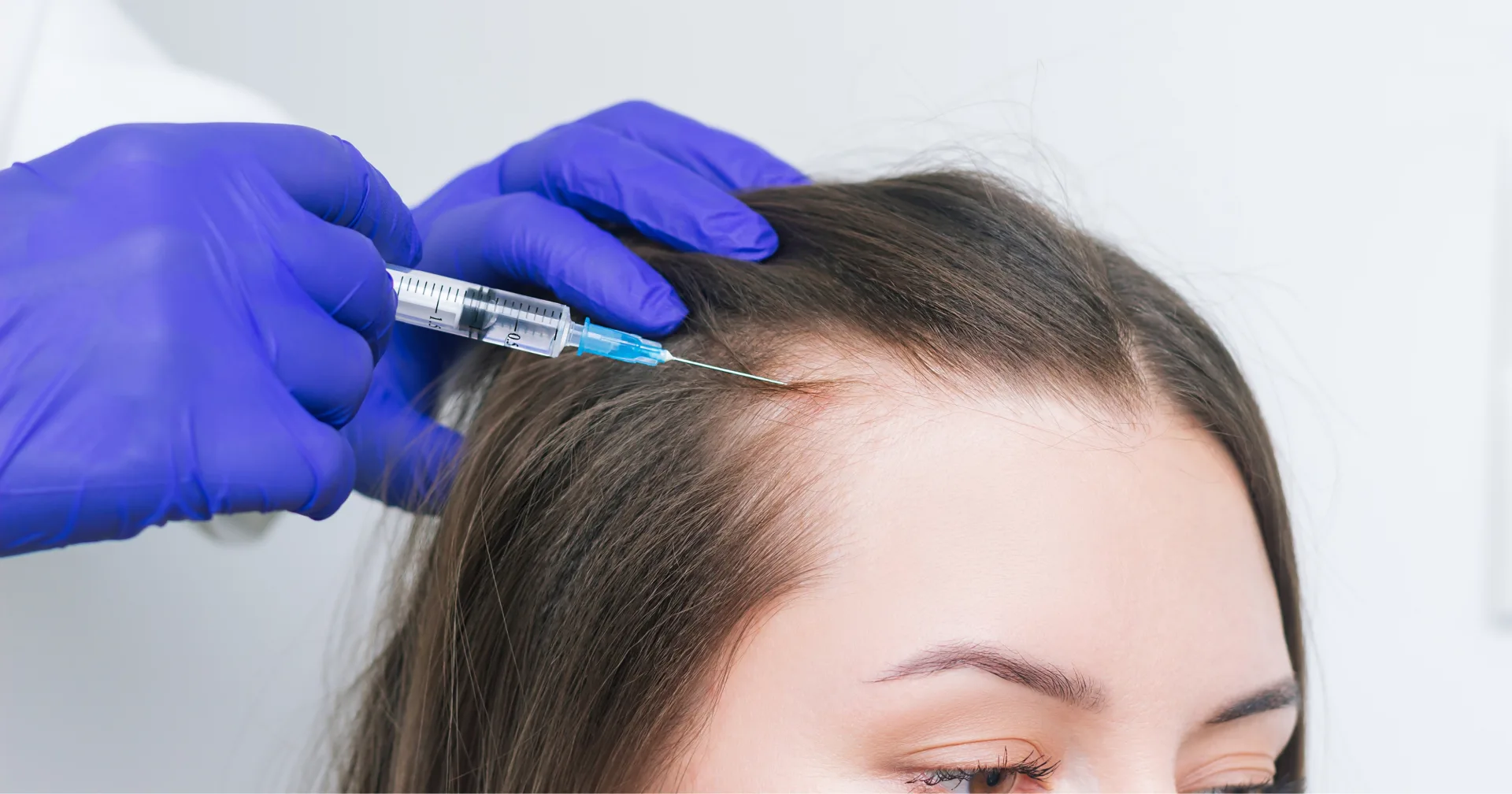
What Is a Hair Filler?
A hair filler is a minimally invasive, injectable treatment administered directly into the scalp. It delivers a concentrated blend of active ingredients, most commonly a biomimetic peptide complex, hyaluronic acid, vitamins, and amino acids, into the dermis at the base of the hair follicle.
Unlike surface-level treatments such as topical serums or shampoos, a hair filler bypasses the scalp's outer barrier entirely. The active ingredients are deposited precisely where follicular activity occurs, at the dermal papilla level, where they can directly influence the biology of hair growth.
It is not surgery. There is no incision, no harvesting of donor hair, no general anaesthesia, and no recovery period. Most patients return to normal activity the same day.
A clinically meaningful middle ground
Hair filler treatment sits in the space between topical care and surgical hair restoration—a clinically meaningful middle ground that many patients are never shown.
How Does a Hair Filler Work?
Understanding the mechanism is what separates genuine clinical treatment from temporary cosmetic masking. Here is what is happening at the follicular level.
The Problem: Follicular Miniaturisation
In androgenetic alopecia, the most common form of hair loss in both men and women, the hormone DHT binds to receptors in the hair follicle's dermal papilla. Over successive growth cycles, the follicle progressively shrinks, producing shorter, finer, less pigmented hairs until it eventually stops producing hair altogether. This process is called follicular miniaturisation, and it is the primary driver of pattern hair loss.
Two molecular pathways accelerate this: BMP4 and DKK-1, both of which suppress follicular activity and shorten the anagen phase, the active growth stage of the hair cycle. When BMP4 and DKK-1 are overactive, the anagen phase shortens, and hair becomes visibly thinner.
The Solution: Peptide-Driven Follicular Regeneration
A clinically formulated hair filler delivers biomimetic peptide molecules that mimic the body's own signalling proteins directly to the follicular environment. These peptides:
- Inhibit BMP4 and DKK-1, removing the molecular brake on follicular activity.
- Extend the anagen phase, giving each follicle more time in active growth.
- Stimulate dermal papilla cells to support follicular regeneration.
- Counteract DHT's effect on genetically susceptible follicles.
- Promote angiogenesis, improving blood supply and nutrient delivery to the follicle.
Hyaluronic acid in the formulation performs a separate but complementary role: it hydrates the scalp's extracellular matrix, improves the follicular microenvironment, and supports the structural scaffolding that healthy hair growth depends on.
ELYARA Hair Filler: How It Works
ELYARA's Hair Filler is the world's first CE-approved injectable hair complex, engineered around a 7-peptide biomimetic complex delivered via proprietary sustained-release technology.
Each peptide targets a distinct pathway in follicular biology:
| Peptide | Primary Action |
|---|---|
| Decapeptide-28 | Hair growth stimulation |
| Oligopeptide-71 | Follicular regeneration support |
| Octapeptide-2 | BMP4 inhibition |
| Decapeptide-18 | DKK-1 inhibition |
| Oligopeptide-54 | Antioxidant follicular protection |
| Octapeptide-11 | Dermal papilla cell activation |
| Decapeptide-10 | Angiogenesis and microcirculation |
Unlike formulations that deliver a single active ingredient, the multi-pathway approach addresses each biological barrier to hair growth simultaneously. ELYARA's double-layer encapsulation technology protects peptides during delivery and its sustained-release mechanism maintains peptide activity across the treatment cycle.
Hair Filler vs. PRP: What's the Difference?
The most common alternative offered in clinics alongside hair fillers is PRP (Platelet-Rich Plasma), a procedure that draws the patient's own blood, concentrates growth factors, and injects them into the scalp.
PRP has an evidence base, but the concentration of growth factors depends on platelet count, the preparation protocol, the centrifuge used, and clinician technique. Hair filler injections with ELYARA are standardised: every vial contains the same defined peptide concentrations, and every session delivers the same reproducible therapeutic dose.
Who Is a Hair Filler For?
Hair filler treatment is most effective for patients with active follicles that have been suppressed rather than permanently lost. The treatment window is broadly:
- Women with early to moderate female pattern hair loss (Savin Scale Stage I-1 through II-2).
- Men with early to moderate androgenetic alopecia.
- Patients experiencing diffuse hair thinning from hormonal changes, stress, or nutritional deficiency.
- Anyone with reduced hair density, weakened hair shaft, or shortened growth cycles.
- Patients who want to maintain results after a hair transplant.
Who should not have this treatment: Hair filler is not recommended during pregnancy or breastfeeding, for patients with active scalp infections or inflammatory skin conditions, those with autoimmune diseases affecting the scalp, or individuals on anticoagulant therapy. A clinical consultation is essential before treatment to confirm suitability.
What Does a Hair Filler Session Involve?
- Before your session: A brief consultation to assess hair loss pattern, review health history, and confirm suitability. Photographs are typically taken for baseline comparison.
- During the session: The scalp is cleansed and a topical anaesthetic may be applied. The hair filler is then injected into the scalp dermis using fine-gauge needles in a series of precisely spaced microinjections. A session takes approximately 30–45 minutes.
- After the session: There is no downtime. Mild redness or sensitivity is normal and typically resolves within 24 hours. Avoid washing hair for the first 24 hours, direct sun exposure and heat styling for 48–72 hours, and alcohol and vigorous exercise for 24 hours.
The ELYARA protocol runs across 4 sessions, spaced 2 weeks apart, for a total treatment duration of 8 weeks. A maintenance session every 3–6 months sustains results.
What Results Can You Expect?
Hair filler results are cumulative and progressive; they build with each session rather than appearing immediately after the first.
- Reduced shedding within the first 2–3 sessions.
- Increased hair density and thickness by the end of the full protocol.
- Improved scalp condition and reduced dryness or sensitivity.
- Stronger, more resilient hair shaft across the treated area.
Results continue to improve in the weeks and months after the final session, as the peptides have stimulated ongoing biological processes: collagen synthesis, hyaluronic acid production, and follicular reactivation that extend beyond the treatment cycle itself. Hair filler does not permanently reverse genetic hair loss; maintenance sessions are required to sustain the biological environment that supports healthy follicular activity.
Frequently Asked Questions
What is a hair filler and how is it different from other hair loss treatments?
A hair filler is a clinically formulated injectable that delivers a biomimetic peptide complex and hyaluronic acid directly into the scalp dermis, targeting the follicular biology of hair loss at its source. Unlike topical treatments that work on the surface, or surgery that relocates follicles, hair filler injections work by reactivating suppressed follicles through molecular signalling.
How does a hair filler work biologically?
Hair fillers deliver biomimetic peptides that bind to receptors in the hair follicle's dermal papilla. These peptides inhibit BMP4 and DKK-1, counteract DHT's effect on genetically susceptible follicles, stimulate dermal papilla cell proliferation, and promote angiogenesis. Hyaluronic acid hydrates the scalp matrix and supports the structural environment for healthy follicular regeneration.
Is hair filler the same as PRP?
No. PRP uses growth factors concentrated from the patient's own blood and varies in potency from session to session and patient to patient. Hair fillers use standardised peptide formulations that deliver consistent, reproducible concentrations every session.
How many sessions of hair filler are needed?
The standard ELYARA protocol involves 4 sessions spaced 2 weeks apart over 8 weeks. A maintenance session every 3–6 months is recommended to sustain results.
Is hair filler treatment painful?
The procedure is minimally invasive and well tolerated. Fine-gauge needles are used and topical anaesthetic is applied beforehand where needed. Most patients describe mild pressure or brief stinging at injection points.
Who is not suitable for hair filler injections?
Hair filler is not recommended during pregnancy or breastfeeding, for patients with active scalp infections, inflammatory skin conditions, autoimmune disorders, or those taking anticoagulants. A consultation with a qualified clinician is required to confirm suitability before treatment begins.
Where can I find a clinic that offers ELYARA Hair Filler?
ELYARA is distributed exclusively through qualified aesthetic physicians, dermatology clinics, and hair restoration practices. Contact ELYARA to find a trained clinic in your region.
Explore ELYARA Hair Filler
Discover the peptide-driven treatment protocol designed to support follicular regeneration.
View Hair Filler