Key takeaways
- Harmonization prioritises proportion, shape, and symmetry over volume.
- The assessment is full-face first: lips are balanced against nose, chin, and lower face.
- Asymmetry and lip borders are addressed before any volume is added.
- Product rheology matters: the lip needs definition without losing natural movement.
- A peptide-integrated HA filler adds immediate structure plus progressive dermal support.
What is Lip Filler Harmonization?
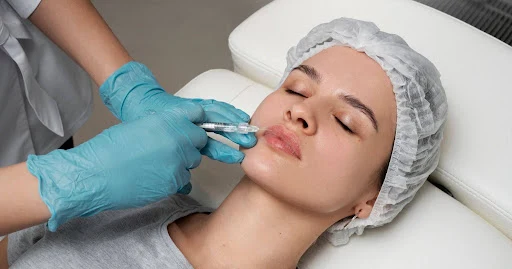
Lip filler harmonization means enhancing the lips so they sit in balance with the rest of the face, not so they stand out from it. Where traditional lip augmentation focused on adding fullness, harmonization treats the lips as one element within the facial composition. The injector considers the relationship between the upper and lower lip, the definition of the cupid's bow and vermillion border, and how the lips relate to the nose, chin, and lower-face proportions. It sits within the broader concept of facial balancing, where the aim across every area is proportion and symmetry rather than isolated volume.
The modern patient reflects this shift too. Increasingly, they ask for natural lip filler results, a refined, proportionate lip, not an obviously augmented one. Harmonization is the technique that delivers it.
Why Proportion Matters More Than Volume
Overfilling is the most common way a lip result goes wrong, and it usually comes from treating size as the goal. A lip that's fuller but out of proportion with the philtrum, the lower face, or the opposite lip reads as "done." Harmonization corrects for this by working to recognised aesthetic ratios (a commonly referenced upper-to-lower lip ratio of roughly 1:1.6), respecting each patient's unique anatomy rather than imposing a template. The result is lips that look balanced in repose and in motion, which is what separates a harmonized outcome from a simply enlarged one.
How Practitioners Approach Lip Filler Harmonization
Experienced injectors follow a sequence, and volume comes last, not first. Broadly, the harmonization approach looks like this:
- Full-face assessment. Before touching the lips, the practitioner evaluates the whole face, nose, chin, jawline, and midface, to understand what balance actually requires. Lips are treated in that context.
- Identify asymmetry and structure. Many lips are naturally asymmetrical: one side higher, a flatter cupid's bow, an under-defined border. These are mapped before any product is chosen.
- Define before you fill. Border definition and correcting asymmetry often come before adding volume. Supporting structure prevents the inward-rolling, "duck" appearance that volume-first technique can create.
- Add volume conservatively, in proportion. Where volume is indicated, it's placed to maintain the upper:lower relationship and the patient's natural anatomy, not to maximise size.
- Assess in movement. The lips are dynamic. A harmonized result has to look natural when the patient speaks, smiles, and rests, which is why product choice and placement depth matter as much as quantity.
Often, lip refinement is the final step after other features are balanced, bringing the whole lower face into harmony rather than drawing the eye to the lips alone.
Product Selection: Why Rheology and Regeneration Matter
The lip is a demanding area: it needs enough structural integrity to hold shape, but enough flexibility to move naturally. That's a rheology question, the filler's elasticity (G') and integration behaviour, not just its volume. A product too stiff for the lip looks rigid in movement; one too soft loses definition.
This is where ELYARA's approach differs from a conventional HA filler. ELYARA's dermal fillers are a peptide-integrated hyaluronic acid, combining cross-linked HA for immediate structural support with integrated biomimetic peptides that support progressive collagen stimulation and tissue regeneration, in a single formulation. It reflects the wider shift the brand describes as from volume to regeneration: the filler does the structural job now, and supports the skin's own biology over the months that follow.
For lip harmonization specifically, ELYARA Dermal Plus is the relevant profile, its product specification explicitly lists harmonization of volume and lip contouring among its indications:
| ELYARA Dermal | Elasticity (G') | Longevity | Depth | Best-suited role in the lower face |
|---|---|---|---|---|
| Plus | 200 Pa | 9–12 months | Mid to deep dermis | Fine lines, skin texture, natural movement, lip contouring & harmonization |
| Ultra | 400 Pa | 12–18 months | Deep to subcutaneous | Structural contouring and volume where facial architecture needs it |
The Standardisation Advantage for Predictable Results
Harmonization depends on predictability, and predictability depends on a consistent product. One reason practitioners move toward standardised regenerative fillers is reproducibility: unlike autologous preparations such as PRP, where concentrations vary between patients and sessions, a CE-approved formulation delivers a defined, consistent composition every time. For a technique as detail-sensitive as lip harmonization, that consistency is part of what makes a refined, repeatable result achievable across a patient base.
What This Means for Your Practice
Harmonization is as much a consultation shift as a technique. Patients increasingly arrive asking for balance, not size, and framing lip treatment as part of full-face harmony, backed by a regenerative, CE-approved filler, positions a practice on the right side of that trend. ELYARA supports clinics with product training, injection protocols, and clinical documentation on onboarding; you can explore the clinical resources or partner with ELYARA to integrate it into your consultations.
The Bottom Line
Lip filler harmonization reflects where aesthetic medicine is heading, away from volume for its own sake, toward proportion, balance, and natural movement. For practitioners, that means assessing the full face, defining and correcting before filling, and choosing a filler whose rheology and regenerative profile suit the lip. Approached this way, lip enhancement stops looking like a treatment and starts looking like the face, only more balanced.
Partner with ELYARA to bring regenerative, CE-approved dermal fillers into your harmonization protocols.
Frequently Asked Questions
How is harmonization different from traditional lip augmentation?
Traditional augmentation focuses on adding fullness. Harmonization treats the lips as part of the whole face, correcting asymmetry, defining borders, and adding volume only in proportion, so the result looks balanced rather than "done."
Which filler is best for lip harmonization?
A hyaluronic acid filler with rheology suited to the lip, enough structure to define, enough flexibility for natural movement. ELYARA Dermal Plus (G' 200 Pa, 9–12 months) lists lip contouring and harmonization of volume among its indications.
How long do lip filler results last?
With HA fillers, lip results commonly last several months to around a year depending on the product and individual factors. ELYARA Dermal Plus offers a longevity of 9–12 months.
Does lip harmonization look natural?
When approached proportionally, defining and balancing before adding conservative volume, and assessing the lips in movement, results are designed to look natural and unforced rather than obviously augmented.
Why choose a peptide-integrated HA filler for lips?
Beyond immediate structural support, a peptide-integrated HA is designed to support progressive collagen stimulation and tissue regeneration over the months after treatment, aligning with the shift from pure volume to regeneration.
Is a standardised filler better than PRP for consistency?
For reproducibility, yes: a CE-approved formulation delivers defined, consistent peptide and HA concentrations every treatment, whereas autologous preparations like PRP vary between patients and sessions.