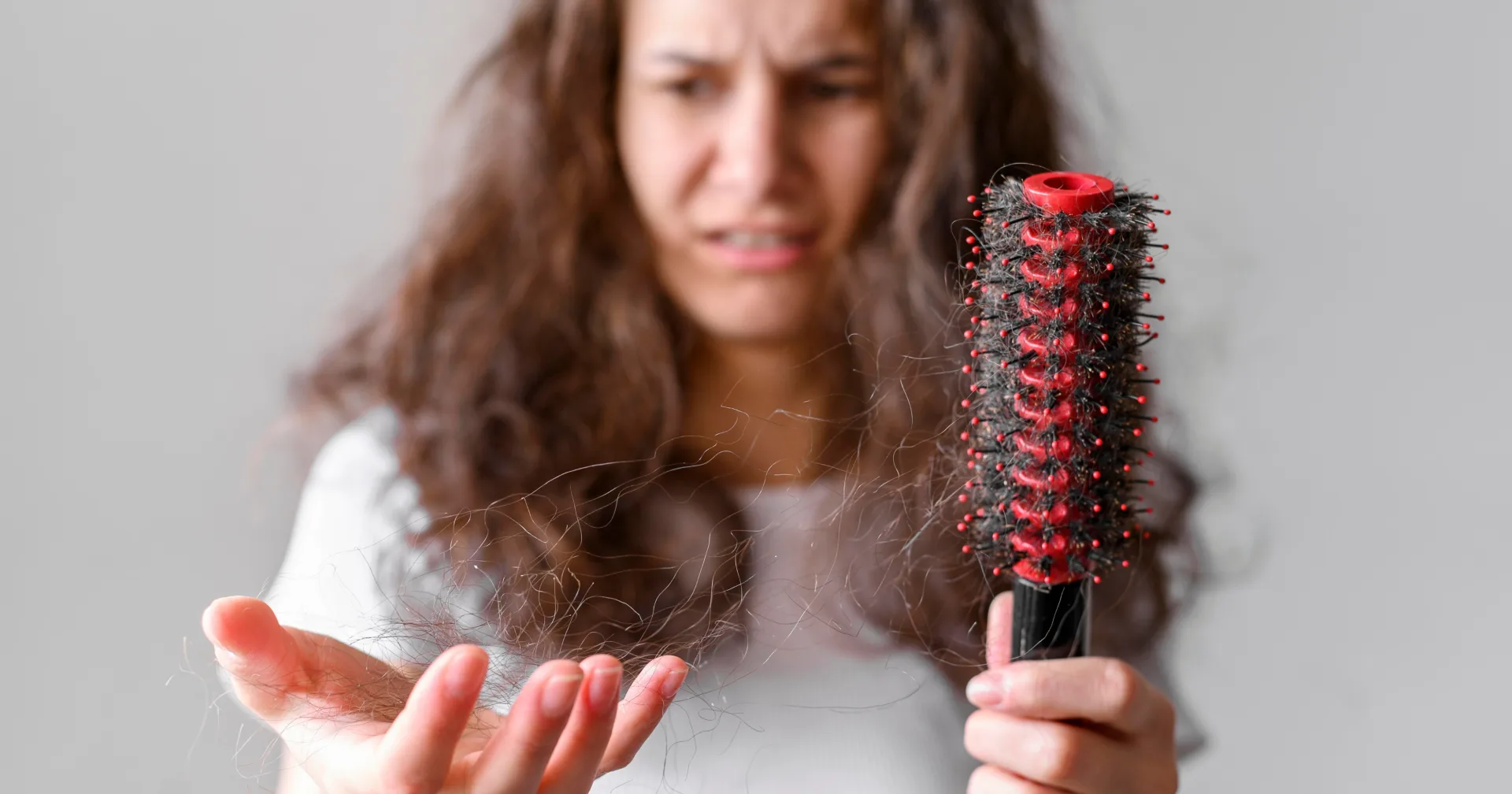
What Is Female Pattern Hair Loss?
Female pattern hair loss (FPHL), also called androgenetic alopecia in women, is a genetically influenced, progressive condition characterised by diffuse thinning over the crown and central scalp. Unlike telogen effluvium, which causes sudden shedding in response to a stressor, FPHL develops gradually over months and years. It does not typically cause a receding frontal hairline the way male pattern baldness does. Instead, women usually retain their frontal hairline while experiencing widening of the central parting, the hallmark of female pattern baldness.
The underlying mechanism is follicular miniaturisation, a process by which hair follicles shrink progressively over repeated growth cycles, producing shorter, finer, less pigmented hairs until the follicle becomes dormant. This is driven primarily by dihydrotestosterone (DHT), a potent androgen metabolite, binding to receptors within the follicle's dermal papilla.
Key distinction
Female pattern hair loss is not the same as female alopecia areata. Alopecia areata is an autoimmune condition that causes patchy hair loss. FPHL is hormonal and genetic, presenting as diffuse, patterned thinning, and it requires a completely different treatment approach.
Hair Loss Causes in Women: What's Really Driving It
Understanding why hair falls is the prerequisite to treating it effectively. Female hair thinning causes are rarely singular; most women presenting with significant hair loss have two or more contributing factors operating simultaneously.
- Genetic predisposition: The single strongest predictor of female pattern baldness. Genetic sensitivity to DHT is inherited and cannot be changed, but it can be managed.
- Hormonal hair loss: Menopause, perimenopause, post-partum hormonal changes, and PCOS hair loss all alter the androgen-oestrogen balance, accelerating androgenic alopecia in susceptible women. Falling oestrogen levels reduce the natural protective buffer against DHT activity at the follicle.
- Iron & nutritional deficiency: Iron deficiency hair loss is one of the most common and most reversible causes of hair thinning in women. Ferritin below 70 ng/mL meaningfully impairs the hair growth cycle. B12, vitamin D, and zinc deficiencies are also established causes of heavy hair fall in female patients.
- Stress-induced shedding (telogen effluvium): A physiological or emotional shock, illness, surgery, crash dieting, or bereavement can push a large proportion of follicles prematurely into the resting phase, causing widespread shedding 6–12 weeks later.
- Thyroid dysfunction: Both hypothyroidism and hyperthyroidism disrupt the hair growth cycle. Thyroid-related hair fall causes are typically diffuse and correctable once the underlying imbalance is addressed medically.
- Medications & medical conditions: Certain contraceptives, antidepressants, blood pressure medications, and chemotherapy agents are established causes of hair loss in women. Always review your medication list with a dermatologist when assessing excessive hair fall.
Telogen Effluvium vs. Androgenetic Alopecia: Know the Difference
- Telogen effluvium is defined by sudden, diffuse shedding often alarming in volume, triggered by a clear stressor event. Hair sheds uniformly across the scalp rather than in a patterned distribution. Most cases resolve within 3–6 months once the trigger is removed.
- Androgenetic alopecia, including diffuse alopecia in women, is chronic, progressive, and patterned. There is no single trigger event; it develops across years. Left untreated, it advances through identifiable stages.
Both conditions can and frequently do occur simultaneously, which is why accurate clinical diagnosis should precede any treatment decision.
Stages of Female Pattern Baldness: The Ludwig Scale
Clinicians use the Ludwig scale, the primary grading tool for female pattern hair loss, to classify severity and guide treatment decisions. Unlike the Norwood scale used for male pattern baldness stages, the Ludwig scale accounts for the diffuse, crown-centred pattern typical in women.
| Stage | Classification | Clinical Presentation |
|---|---|---|
| Stage I | Mild | Minimal widening of the central parting. Hair volume may feel reduced; rarely visible to others. Most amenable to treatment; best outcomes are achieved here. |
| Stage II | Moderate | Noticeable widening and diffuse loss across the crown. Scalp visibility increases. Regenerative treatment at this stage can meaningfully restore density. |
| Stage III | Advanced | Near-total hair loss at the crown with widely visible scalp. Frontal hairline generally preserved. Treatment can slow further progression; surgical assessment may be appropriate for eligible candidates. |
A dermatologist may also use the Savin scale, which includes a density scoring component, or dermoscopy to directly assess the degree of follicular miniaturisation often detectable before visible thinning is apparent.
Hair Loss Treatment for Women in 2026: Full Spectrum
There is no single best hair loss treatment for females—the right protocol depends on the type of alopecia, stage, hormonal profile, and individual health history.
Topical & Oral Pharmacology
- Minoxidil (topical 2%/5% or oral low-dose): The only FDA-approved topical for female pattern hair loss treatment. It prolongs the anagen phase and increases follicular size. Effects reverse if discontinued.
- Spironolactone: An anti-androgen that blocks DHT at the receptor level. Widely used in hormonal hair loss and PCOS hair loss treatment. Contraindicated in pregnancy.
- Finasteride / Dutasteride: 5-alpha reductase inhibitors that reduce systemic DHT production. Used off-label in post-menopausal women as androgenic alopecia treatment and remain under specialist management.
- Iron & nutritional correction: An essential first step when deficiency is confirmed. Ferritin, B12, vitamin D, and zinc should be assessed and corrected before layering additional interventions.
Regenerative Injectable Therapy & Scalp Revitalization
Injectable scalp revitalization treatments work at the molecular level to reactivate follicular biology, addressing follicular miniaturisation at its source.
ELYARA's Hair Filler is the world's first CE-approved injectable hair complex, delivering seven synergistic biomimetic peptides via sustained-release technology. The formulation targets four distinct biological pathways:
- Hair growth stimulation—directly activating follicular cell proliferation
- Inhibition of BMP4 and DKK-1, the molecular drivers of androgenetic alopecia
- Antioxidant follicular protection—reducing oxidative stress-driven miniaturisation
- Angiogenesis stimulation—improving nutrient and oxygen supply to the dermal papilla
It is clinically indicated for female patients across the Savin Scale Stage I-1 through II-2, the window where intervention produces meaningful restoration. Unlike PRP, ELYARA delivers standardised, reproducible peptide concentrations every session.
PRP (Platelet-Rich Plasma)
PRP draws growth factors from the patient's own blood and injects them into the scalp. It remains a widely used hair growth treatment for women, but results are highly variable, dependent on platelet concentration, preparation protocol, and individual response.
Hair Transplant Surgery
Surgical restoration is appropriate only for women with stable, patterned loss and a healthy, non-miniaturised donor zone at the occipital scalp. Specialist assessment is essential before pursuing this route.
How to Stop Hair Thinning
For women asking how to stop hair thinning or how to regrow thinning hair, the most important first step is accurate diagnosis. A trichologist or dermatologist can:
- Run targeted blood panels: ferritin, thyroid function, androgens, B12, and vitamin D.
- Perform scalp dermoscopy to assess follicular miniaturisation directly.
- Distinguish between the overlapping types of hair loss driving a specific presentation.
Treatment initiated before follicles are permanently lost consistently produces better, more durable outcomes. Early-stage FPHL is far more responsive to both topical and regenerative intervention than advanced loss.
The Bottom Line
Female pattern hair loss is common, progressive, and—when identified early—very treatable. Understanding the specific type of hair loss, staging it accurately on the Ludwig scale, and selecting treatments that address the underlying mechanism rather than just symptoms is what separates meaningful recovery from temporary management.
Frequently Asked Questions
Which hormone causes hair loss in females?
Dihydrotestosterone (DHT), a byproduct of testosterone, is the primary hormone responsible for female pattern hair loss. DHT binds to receptors in the hair follicle and triggers follicular miniaturisation.
How much hair loss is normal per day for women?
Losing 50–100 hairs per day is considered normal hair fall for women. If shedding is consistently greater or thinning becomes visible, a clinical assessment is recommended.
What is the difference between telogen effluvium and androgenic alopecia?
Telogen effluvium is sudden, diffuse shedding triggered by a stressor, illness, crash dieting, childbirth, or severe emotional stress. Androgenic alopecia is a gradual, genetically driven process caused by DHT sensitivity, producing patterned thinning at the crown and central parting.
Can female pattern hair loss be reversed?
FPHL cannot be fully reversed once follicles have permanently miniaturised and become dormant. However, early-stage treatment can halt progression and restore hair density in follicles that are still active.
What is the Ludwig scale?
The Ludwig scale is the most widely used clinical grading system for female pattern baldness. Stage I indicates minimal thinning; Stage II shows wider central thinning; and Stage III presents as advanced thinning with near-total loss at the crown.
Does PCOS cause hair loss in women?
Yes. PCOS elevates androgen levels, which can trigger or accelerate androgenetic alopecia in women. Managing underlying androgen levels alongside targeted hair growth treatment is essential to effective management.
Am I going bald if I can see my scalp?
Seeing the scalp slightly is not automatically a sign of baldness; density naturally varies and lighting can make healthy hair appear thin. However, progressively increased scalp visibility at the crown or central parting warrants clinical assessment.
Explore ELYARA Hair Filler
Discover a CE-approved regenerative injectable engineered to address follicular miniaturisation at the molecular level.
View Hair Filler